
MUST YOU RETURN MONEY THAT ISN’T YOURS?
September 19, 2026WHY NIGERIAN BUSINESSES MUST PROTECT THEIR INTELLECTUAL PROPERTY.
September 21, 2026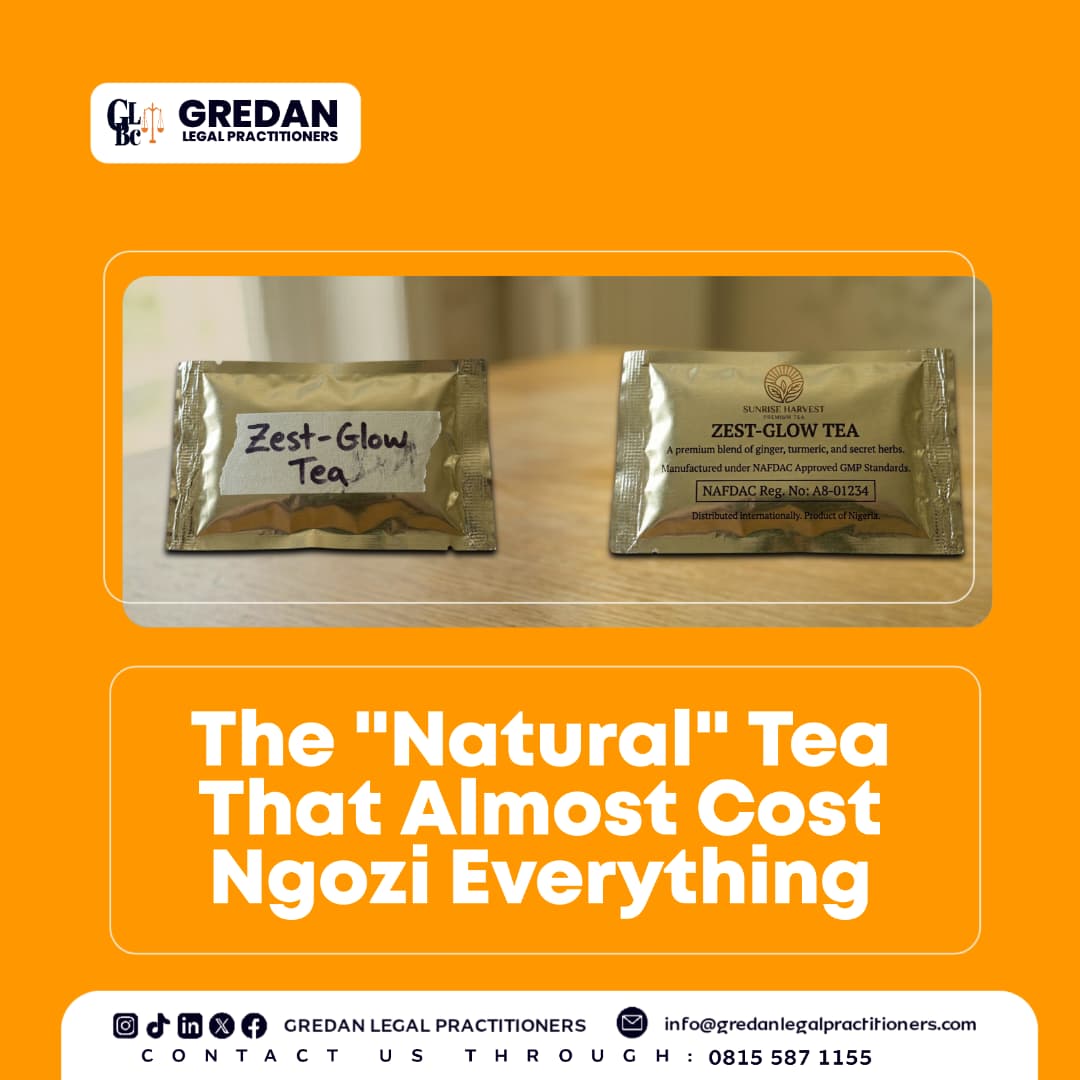
The “Natural” Tea That Almost Cost Ngozi Everything: Why NAFDAC Registration Matters for Food and Herbal Products in Nigeria
For many small business owners in Nigeria, a business often starts from something simple: a recipe perfected at home, a product shared with friends and family, and eventually, a few customers who begin asking for more.
That was exactly how Ngozi’s business started.
In her kitchen in Surulere, Lagos, Ngozi had perfected a herbal tea blend made from ginger, turmeric and other herbs. What started as something she prepared for friends soon became a growing business. Orders came through WhatsApp and Instagram, her packaging became more professional, and within a short time, thousands of people were following her brand online.
Then came the opportunity she had been waiting for.
A major supermarket chain contacted her and expressed interest in stocking her tea. They wanted hundreds of units delivered within a few days.
Ngozi was thrilled. She had finally found a way to take her business from selling directly to individual customers to getting her product onto supermarket shelves.
But when she arrived at the supermarket warehouse with her products, the excitement quickly disappeared.
The purchasing manager examined the packaging and asked a simple question:
“Where is the NAFDAC registration number?”
Ngozi explained that the tea was made from natural ingredients and that she had not yet completed the registration process.
The supermarket could not accept the products.
For Ngozi, the problem was not that her tea was unpopular. She had customers. She had social-media followers. She had good reviews. She even had an attractive brand.
The problem was regulatory compliance.
Being “Natural” Does Not Automatically Exempt a Product From NAFDAC Regulation
One of the common misconceptions among small-scale food and herbal-product businesses is that products made from natural ingredients do not require regulatory approval.
That is not necessarily the case.
NAFDAC regulates a wide range of products in Nigeria, including food, drugs, cosmetics, medical devices and other regulated products. Whether a particular product requires registration depends on how it is classified and the applicable regulatory requirements.
Therefore, the fact that a product is described as “natural,” “organic,” “herbal” or “chemical-free” does not, by itself, take the product outside NAFDAC’s regulatory framework.
This is particularly important for entrepreneurs producing packaged foods, beverages and herbal preparations for commercial distribution.
A product that is being manufactured and marketed commercially must be considered from the beginning not only as a business idea, but also as a regulated product.
Why NAFDAC Registration Matters When Your Business Wants to Scale
Ngozi’s experience highlights a problem many growing businesses eventually encounter.
Selling directly to friends, family members, social-media followers or individual customers may allow a business to operate on a relatively small scale. But once the business begins targeting supermarkets, pharmacies, distributors, larger retailers or export markets, regulatory compliance becomes increasingly important.
Large retailers generally have their own compliance requirements before they will stock products. A supplier may be required to provide evidence that the product has been properly registered or approved by the relevant regulatory authority.
This means that a business can have excellent branding, thousands of followers and strong customer demand but still be unable to secure major distribution opportunities if its regulatory requirements have not been addressed.
For an entrepreneur hoping to grow a food or herbal-product business, NAFDAC compliance should therefore not be treated as something to consider only after the business becomes successful.
It should form part of the business plan from the beginning.
NAFDAC Registration Is More Than Just Getting a Number
It is also important to understand what registration involves.
NAFDAC registration is not simply a matter of obtaining a number and printing it on a package. Depending on the nature and classification of the product, the regulatory process may involve requirements relating to the product itself, the manufacturing premises, labelling, documentation, quality control and other applicable standards.
This is particularly important for businesses producing consumable products.
An entrepreneur may have a good recipe, but that does not necessarily mean the production process, premises, packaging or labelling satisfies the applicable regulatory requirements.
For businesses that intend to operate on a larger scale, this distinction can make the difference between being able to enter formal retail channels and being turned away at the warehouse door.
What Happens When a Business Ignores Regulatory Requirements?
Ngozi’s problem could have become much more serious if she continued manufacturing and distributing her products without addressing the applicable regulatory requirements.
NAFDAC has regulatory and enforcement powers over products within its jurisdiction. Depending on the circumstances, regulatory authorities may take enforcement action against businesses that manufacture, distribute or sell products in violation of applicable requirements.
For a small business, the financial consequences can be significant.
Products may be detained or seized, business operations may be disrupted, and the entrepreneur may face other regulatory consequences depending on the nature of the violation.
Beyond government enforcement, there is also the commercial damage.
Imagine spending hundreds of thousands of naira producing and packaging a product only to discover that a major retailer cannot stock it because the necessary regulatory requirements have not been satisfied.
That is money tied up in inventory that may not be commercially usable in the way the entrepreneur intended.
What About Customer Complaints?
Ngozi’s second problem demonstrates another reason regulatory compliance matters.
Suppose a customer alleges that a product caused a reaction or illness. The allegation itself does not automatically establish that the product caused the problem. There could be several possible explanations, including individual sensitivity, improper use, contamination, storage problems or other factors.
However, when a business has proper documentation, quality-control procedures and regulatory records, it is in a much stronger position to investigate and respond to such complaints.
Regulatory compliance should therefore not be presented as a guarantee that a product can never cause harm or that the manufacturer can never face liability.
Rather, it forms part of a broader system of quality assurance, accountability and regulatory oversight.
A responsible manufacturer should be able to demonstrate what goes into the product, how it is produced, how it is packaged and how quality is maintained.
The Bigger Lesson for Nigerian Entrepreneurs
Ngozi’s biggest mistake was not creating a herbal tea.
Her mistake was treating regulatory compliance as something she could deal with later.
Many entrepreneurs concentrate heavily on branding, social-media marketing, packaging and sales while overlooking the legal and regulatory requirements attached to the product they are selling.
But a business does not become truly ready for growth simply because customers love the product.
It also needs the legal foundation to support that growth.
If your goal is to move from Instagram and WhatsApp sales to supermarkets, distributors, pharmacies or export markets, you should consider regulatory requirements before investing heavily in production and inventory.
For businesses dealing with food, beverages, herbal products and other NAFDAC-regulated products, this includes determining the appropriate regulatory classification, understanding the applicable registration requirements, ensuring that the production environment meets the relevant standards, and making sure that the product’s packaging and labelling comply with applicable requirements.
From Kitchen Business to Serious Brand
Ngozi eventually recognised that her product needed more than good reviews and attractive packaging.
She sought professional legal guidance, reviewed her production process, worked towards meeting the applicable regulatory requirements and completed the necessary registration process.
Her business could then pursue opportunities that had previously been out of reach.
That is the real lesson.
Regulatory compliance should not be viewed merely as an obstacle standing between an entrepreneur and a supermarket shelf. For a growing business, it is part of building a product that can enter formal markets and withstand greater commercial scrutiny.
Your product may be natural. Your customers may love it. Your Instagram page may have thousands of followers.
But if you want to take the business to the next level, ask yourself a more important question:
Is the business legally and regulatorily ready to scale?
For entrepreneurs manufacturing or selling food, beverages, herbal products and other regulated products in Nigeria, getting the right regulatory advice early can help prevent costly mistakes later.
Do not wait until your biggest business opportunity arrives before discovering that your product is not ready for the market.