
WHAT TO EXPECT WHEN TAKING A CIVIL CASE TO COURT IN NIGERIA.
September 17, 20266 ESSENTIAL DOCUMENTS EVERY BUSINESS OWNER IN NIGERIA MUST HAVE.
September 19, 2026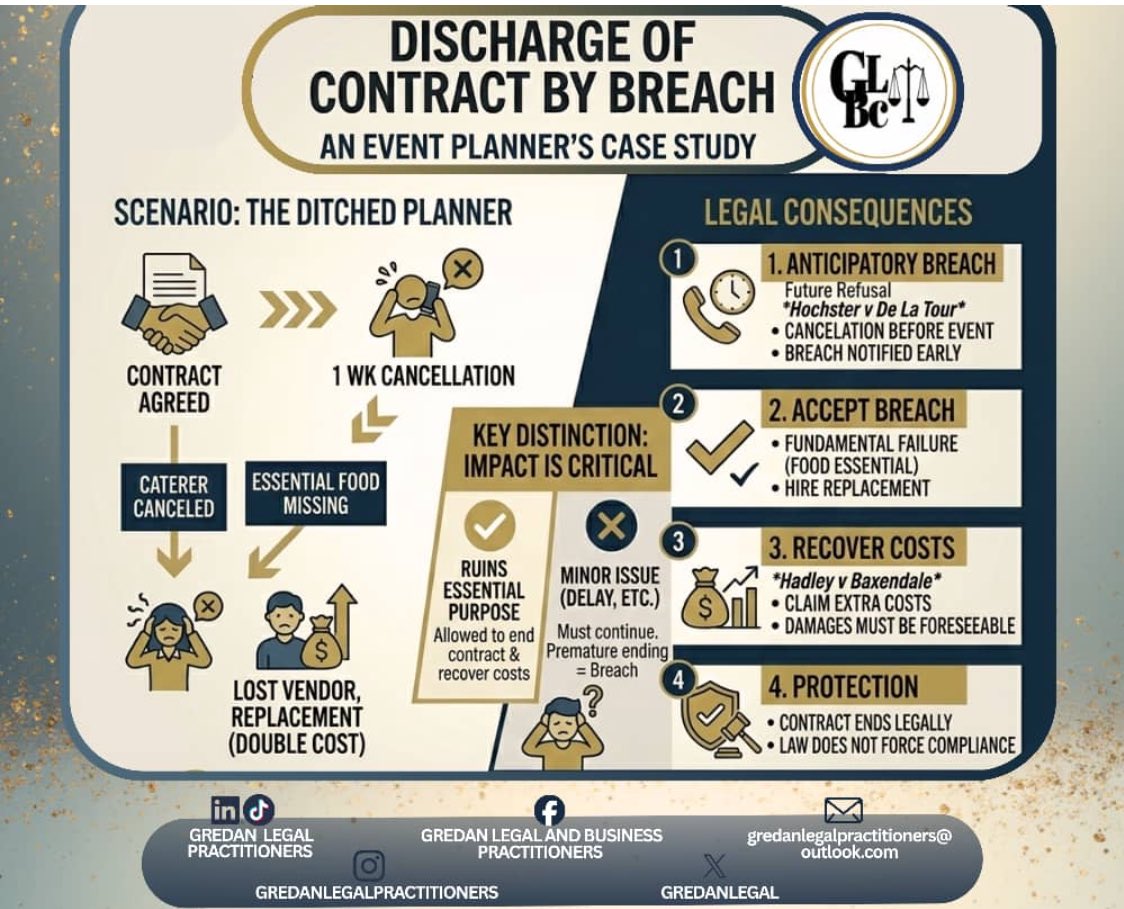
DISCHARGE OF CONTRACT BY BREACH: WHEN CAN YOU END A CONTRACT?
Imagine you have been hired as the official event planner for a major client. This is not just another job. It is the kind of opportunity that could significantly boost your career, so you take every detail seriously.
The client contacted you four months before the event, giving you enough time to plan properly. You contacted interior décor suppliers, food vendors, wine merchants, sound and lighting experts, and rental companies. Meetings were held, agreements were reached, deposits were paid, and everything appeared to be falling into place.
The catering arrangement was particularly important. Eight hundred guests were expected, the menu had been agreed upon, the price had been fixed, and a contract had been signed with the food vendor.
Then, one week before the event, the vendor called.
He told you that he would no longer be able to supply the food because he had accepted another, larger event taking place at the same time and had decided to prioritise that client over yours.
Suddenly, you have only seven days to find another caterer. Most reputable vendors are already booked, and after several frantic calls, you finally find someone who can take the job, but at twice the original price.
You have little choice. Without food, the event cannot go ahead as planned.
So, what happens legally?
WHAT IS DISCHARGE OF CONTRACT BY BREACH?
A contract creates obligations for the parties involved. When one party fails to perform an obligation in accordance with the terms of the agreement, that failure may amount to a breach of contract.
In certain circumstances, a breach can give the innocent party the right to bring the contract to an end and potentially claim damages for losses suffered as a result.
However, not every breach gives a party the right to terminate a contract. The nature and seriousness of the breach matter.
WHAT IS AN ANTICIPATORY BREACH?
In the event-planning example, the food vendor did not wait until the day of the event to fail to provide the food. He informed you one week beforehand that he would not perform his contractual obligation.
This is known as an anticipatory breach.
An anticipatory breach occurs where, before the time fixed for performance, one party clearly indicates that they will not perform their contractual obligation.
The principle was established in Hochster v De La Tour (1853), where the court recognised that a party does not necessarily have to wait until the date of performance before responding to a clear refusal to perform.
In such a situation, the innocent party generally has a choice. They may accept the repudiation and treat the contract as discharged, or they may affirm the contract and continue to hold the other party to it.
In our example, by accepting the vendor’s refusal and engaging another caterer, the event planner would be treating the vendor’s repudiation as bringing the contractual relationship to an end.
BUT DOES EVERY BREACH ALLOW YOU TO TERMINATE A CONTRACT?
This is where things become important.
A breach of contract does not automatically give the innocent party the right to terminate the agreement. The law distinguishes between breaches that are sufficiently serious to justify termination and breaches that may only give rise to a claim for damages.
The classic illustration is Hong Kong Fir Shipping Co Ltd v Kawasaki Kisen Kaisha Ltd (1962), which developed the concept of an “innominate term”. The court considers the consequences of the breach and asks whether the innocent party has been deprived of substantially the whole benefit they were supposed to receive under the contract.
Consider the event-planning situation again.
The food vendor’s obligation was not incidental. Catering was a central part of the agreement. With 800 guests expected, the vendor’s refusal to provide the food just one week before the event could have a substantial impact on the entire event.
This is very different from a minor breach, such as a relatively insignificant delay or small defect that does not substantially affect the purpose of the agreement.
The seriousness of the breach is therefore important when determining whether the innocent party can terminate the contract.
WHAT HAPPENS AFTER THE CONTRACT IS TERMINATED?
Where a party has the legal right to terminate a contract because of a sufficiently serious breach, they may also be able to claim damages for losses caused by that breach.
This brings us to the principle in Hadley v Baxendale (1854).
Generally, damages for breach of contract are intended to compensate for losses that arise naturally from the breach or losses that were reasonably within the contemplation of the parties when the contract was made.
In the event-planning example, the need to obtain another caterer is a foreseeable consequence of a caterer’s refusal to perform shortly before a major event.
If the replacement caterer charges twice the original price, the additional expense may potentially form part of the damages claimed, subject to the applicable rules on remoteness, causation and mitigation.
THE DUTY TO MITIGATE YOUR LOSS
There is another important consideration: the innocent party cannot simply allow losses to accumulate and expect the breaching party to pay for everything.
The law generally requires a claimant to take reasonable steps to mitigate their losses.
In this situation, that could mean making reasonable efforts to find another caterer rather than simply allowing the event to fail.
The fact that the replacement caterer costs more does not necessarily prevent a claim. What matters is whether the additional expense was reasonably incurred in responding to the breach.
WHAT IF THE BREACH IS MINOR?
Imagine that the caterer had not cancelled the entire arrangement but had simply informed you that some of the drinks would arrive two hours late.
That situation could be very different.
If the breach is not sufficiently serious to justify termination, attempting to end the entire contract could itself amount to a breach.
This is why it is important not to assume that every contractual failure gives you the right to walk away from an agreement.
The terms of the particular contract, the nature of the obligation involved and the consequences of the breach all matter.
WHY DOES THIS MATTER IN BUSINESS?
Contracts are designed to create certainty. Businesses rely on suppliers, service providers, customers and other contractual partners to perform their obligations at agreed times and under agreed terms.
When one party suddenly refuses to perform, the consequences can extend far beyond the immediate contractual obligation. A delayed delivery can disrupt production. A supplier’s refusal can leave a business scrambling for alternatives. A service provider’s failure can cause additional expenses and damage relationships with customers.
Understanding when a breach allows you to terminate a contract can therefore be extremely important.
The key issue is not simply whether a breach has occurred. The real question is whether the breach is serious enough, under the terms of the contract and the applicable law, to give the innocent party the right to terminate and pursue the appropriate remedies.
CONCLUSION
Discharge of contract by breach occurs where a party’s failure to perform their contractual obligations is sufficiently serious to entitle the innocent party to bring the contract to an end.
The law, however, does not treat every breach in the same way. A minor breach may result in a claim for damages without giving the innocent party the right to terminate, while a serious breach may justify termination and a claim for losses.
The distinction can have significant financial consequences, particularly in commercial transactions where one party’s failure can force the other to spend more money, find alternative suppliers or reorganise an entire business arrangement.
Before terminating a contract because of a breach, it is therefore important to examine the contract carefully and determine whether the breach actually gives you that right. A decision to walk away from a contract without sufficient legal grounds can create a new breach and expose you to liability.