
WHY PROPER BUSINESS DOCUMENTATION MATTERS.
September 21, 2026LEGAL DOCUMENTS EVERY BUSINESS OWNER SHOULD HAVE.
September 26, 2026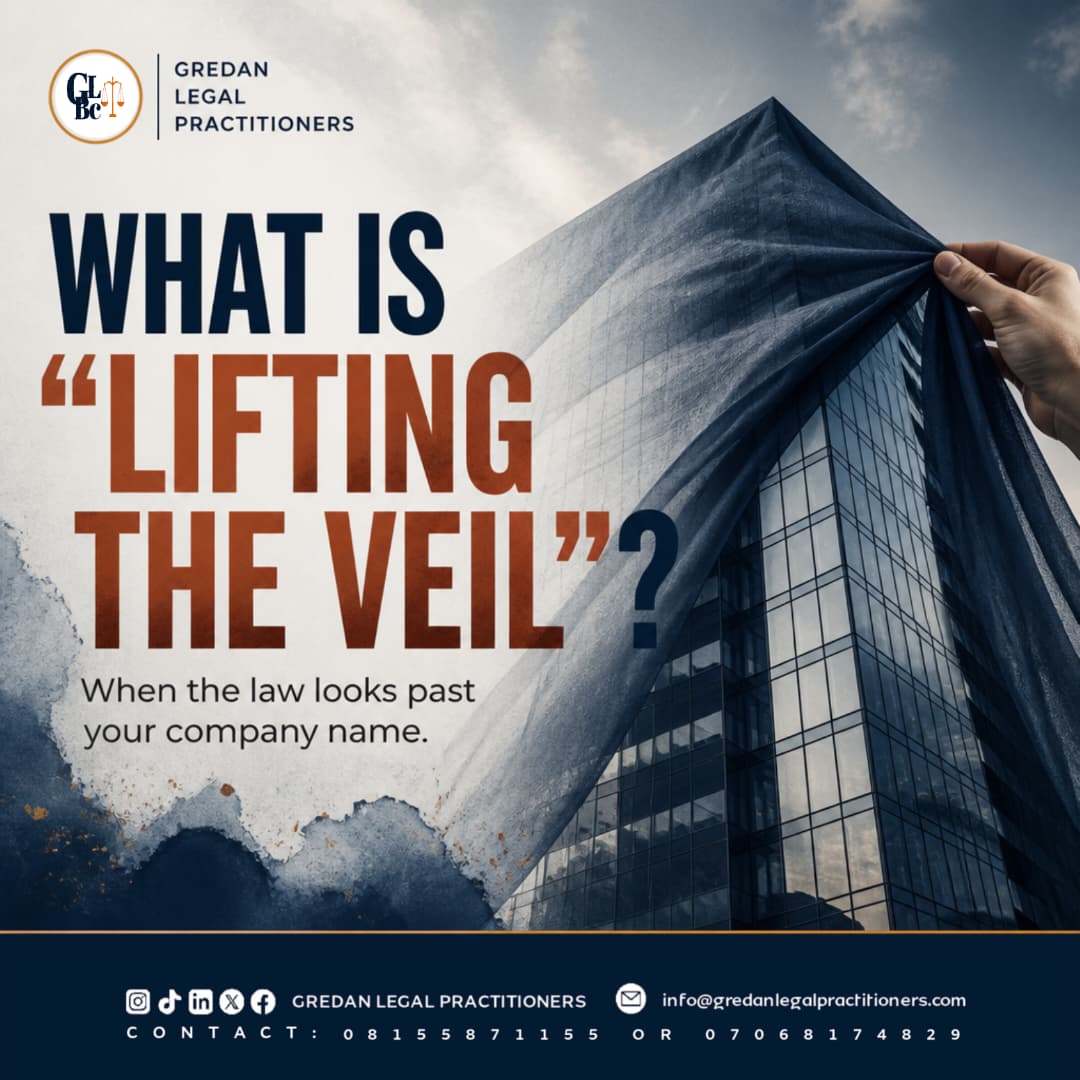
Lifting the Corporate Veil Under Nigerian Law: When Can a Company’s Separate Identity Be Ignored?
One of the major advantages of incorporating a company in Nigeria is that the company becomes a legal person separate from the individuals who own or manage it.
This principle is commonly described as the corporate veil.
It means that once a company is properly incorporated, the law generally treats the company as a separate legal entity from its shareholders and directors. The company can own property, enter into contracts, sue and be sued, and incur debts in its own name.
More importantly for business owners, the company’s liabilities are generally treated as the company’s liabilities, rather than the personal liabilities of its shareholders.
But this protection is not unlimited.
In certain circumstances, the court may look beyond the company’s separate legal personality and examine the individuals behind it. This is commonly referred to as lifting or piercing the corporate veil.
What Is the Corporate Veil?
The corporate veil is the legal separation between a company and the individuals behind it.
Once a company is incorporated, it does not simply become a name attached to its owners. It becomes a separate legal entity in the eyes of the law.
This principle was famously established in the English case of Salomon v A Salomon & Co Ltd, which has strongly influenced company law in Nigeria.
For example, imagine that Ade owns a company called Ade Ventures Ltd. The company enters into a ₦20 million contract with another business and later fails to pay the debt.
Ordinarily, the creditor’s claim is against Ade Ventures Ltd, not automatically against Ade personally. The fact that Ade owns the company does not, by itself, make him personally responsible for every debt incurred by the company.
This separate legal personality is one of the fundamental features of incorporation.
What Does “Lifting the Corporate Veil” Mean?
Lifting the corporate veil occurs when the court, in circumstances recognised by law, looks beyond the company’s separate legal personality.
Instead of treating the company as the only relevant legal actor, the court may examine the conduct of the individuals controlling or using the company.
The purpose is not simply to punish someone for owning a company. Rather, the principle prevents the corporate structure from being misused to produce an unjust or unlawful result.
For example, a person should not be able to create or use a company merely as a device for carrying out fraud or avoiding an existing legal obligation and then argue that the company is a completely separate person whenever responsibility arises.
When Can the Corporate Veil Be Lifted?
The circumstances in which courts may disregard separate corporate personality are limited and depend on the facts of each case and the applicable law.
One important situation is where a company is being used for fraud or other unlawful purposes. Incorporation does not give individuals permission to use a company as a vehicle for wrongdoing.
The corporate structure may also come under scrutiny where it is being used as a sham or façade to evade an existing legal obligation. The courts may examine the substance of the transaction rather than allowing the company structure to be used simply as a means of avoiding responsibility.
There are also circumstances created specifically by legislation where individuals behind a company may incur personal liability. This is why company directors and officers must understand that limited liability is not the same thing as complete immunity from personal responsibility.
Does Owning a Company Mean You Can Never Be Personally Liable?
No.
This is one of the most common misunderstandings about incorporation.
The fact that a company is a separate legal entity does not mean that its directors or shareholders can never be held personally responsible for their own conduct.
A director who personally commits a wrong, acts outside the protection available under the law, gives a personal guarantee, or falls within a statutory provision imposing personal liability may have personal exposure depending on the circumstances.
Similarly, the mere existence of a company does not automatically protect individuals who deliberately misuse the corporate structure.
The key distinction is that limited liability protects shareholders and other persons only within the scope recognised by law; it is not a licence to commit wrongdoing through a company.
How Can Business Owners Maintain Proper Corporate Separation?
Business owners who want to preserve the benefits of separate legal personality should treat the company as a genuine separate entity.
Personal and company finances should be properly separated. Company bank accounts should be used for company transactions rather than treating corporate funds as a personal wallet.
The company should also maintain proper records, comply with applicable statutory requirements, keep appropriate corporate documentation and ensure that its transactions are properly authorised.
Contracts should clearly identify the correct legal entity, and business owners should avoid using the company’s name as a cover for personal transactions or unlawful activities.
These practices do not guarantee that the corporate veil can never be lifted, but they help demonstrate that the company is being operated as a genuine legal entity rather than being used as a mere instrument for personal wrongdoing.
The Importance of Separate Legal Personality
The corporate veil is one of the reasons businesses incorporate in the first place.
It provides a legal distinction between the company and its owners, allowing businesses to enter transactions, acquire assets and incur obligations in their own name.
But that protection comes with responsibilities.
A company should not be treated as a personal extension of its shareholders whenever convenient and then suddenly treated as a completely separate person when liabilities arise.
The corporate structure works best when the company is genuinely operated as a separate legal entity and its statutory and legal obligations are taken seriously.
Final Thoughts
Lifting the corporate veil does not mean that courts routinely make company owners personally liable for corporate debts. Separate legal personality remains a fundamental principle of company law.
However, the protection offered by incorporation has limits.
Where the corporate structure is abused, or where legislation provides for personal liability, the individuals behind the company may face personal consequences.
For business owners in Nigeria, the lesson is simple: incorporation provides protection, but that protection must be respected and properly maintained.
Understanding the rules surrounding corporate personality, limited liability and lifting the corporate veil is therefore essential for anyone operating or managing a company under Nigerian law.