
TYPES OF COMPANIES IN NIGERIA.
September 26, 20264 WAYS LEGAL ADVICE PROTECT YOUR BUSINESS
September 27, 2026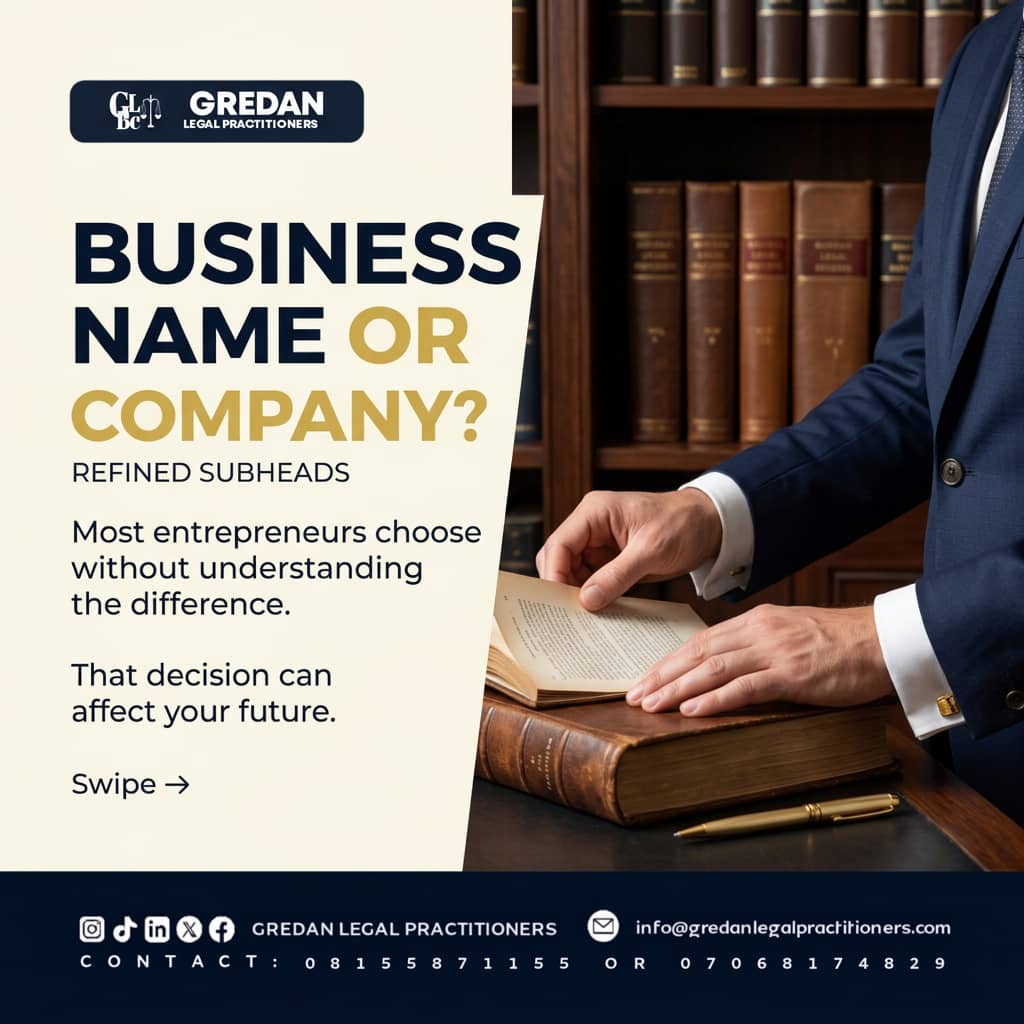
Business Name vs Company in Nigeria: What Is the Difference?
Business name or company?
It is one of the first decisions many Nigerian entrepreneurs face when formalising a business.
Both are recognised ways of carrying on business in Nigeria, but they are not the same legal structure.
The choice can affect issues such as liability, ownership, financing, continuity and regulatory obligations. This is why choosing between a business name and a company should be based on more than which one is easier or cheaper to register.
What Is a Business Name?
A business name is a name under which an individual, partnership or other registrant carries on business.
For example, imagine that Chika runs a fashion business called Chika Styles and registers the name as a business name.
The registration of “Chika Styles” does not create a separate legal person that is different from Chika in the same way that incorporation of a company does.
This distinction is important when considering liability and ownership.
What Is a Company?
A company incorporated under the Companies and Allied Matters Act 2020 (CAMA 2020) has a legal personality separate from its members.
This means that the company is generally treated as a legal person distinct from the individuals who own or manage it.
The principle was famously established in Salomon v A Salomon & Co Ltd, which established the separate legal personality of an incorporated company.
So, if Chika incorporates Chika Styles Ltd, the company is legally distinct from Chika.
That distinction can have significant consequences for the business.
Business Name vs Company: Who Actually Owns the Business?
This is one of the biggest differences.
With a business name, the business does not become a separate legal person merely because the name is registered.
With a company, the company itself owns its assets, enters into contracts and incurs liabilities in its own name, subject to the law.
The shareholders own shares in the company; they do not personally own the company’s assets simply because they are shareholders.
What Happens When the Business Has Debts?
Liability is another important consideration.
With a business name operated by a sole proprietor, the business and its owner are not separated by incorporation. This means that the owner’s personal assets may be exposed to claims against the business, subject to applicable law and the particular circumstances.
A company limited by shares, on the other hand, generally provides limited liability to its members.
Under the usual principle, shareholders’ liability is limited to the amount, if any, unpaid on the shares they hold.
However, limited liability is not an absolute shield. There are circumstances under company law where individuals may incur personal liability, and the corporate structure must not be used for unlawful purposes.
Can a Business Name Attract Investors?
A business name can certainly grow and generate substantial revenue, but its structure is different from that of a company with share capital.
A company limited by shares has a formal shareholding structure, which can make it more suitable where founders intend to bring in shareholders or structure ownership through shares.
Companies can also have different financing options depending on their structure and applicable legal and regulatory requirements.
For an entrepreneur planning to build a business that will eventually involve multiple investors, the corporate structure may therefore be an important consideration.
What Happens If the Owner Leaves?
A company has perpetual succession.
This means that the company’s existence is not ordinarily brought to an end simply because one shareholder dies, leaves the business or transfers their shares.
The company remains a separate legal entity, even though its ownership or management may change.
A business operated by an individual is more closely connected to its proprietor. What happens to the business when the proprietor dies, becomes unavailable or stops operating can depend on the circumstances and the arrangements that have been made.
Business Name vs Company: Which Is Simpler?
A business name is generally simpler to establish and maintain than an incorporated company.
A company, however, comes with additional corporate requirements and ongoing compliance obligations.
These can include matters relating to directors, shareholders, statutory filings, corporate records and other requirements applicable to the particular company.
Therefore, the simpler option is not automatically the more suitable option.
The right question is:
What does your business need now, and where do you want it to go?
Which Should You Choose?
There is no single structure that is right for every entrepreneur.
A business name may be suitable for someone operating a small business or testing a business idea where the additional corporate structure of a company is not presently necessary.
A company may be more appropriate where the entrepreneur intends to build a larger operation, bring in shareholders, separate the business from the owners legally or pursue certain growth and investment plans.
The decision should be based on the nature and objectives of the business rather than simply on registration cost.
Common Mistake: Choosing Based Only on Cost
One of the common mistakes entrepreneurs make is thinking:
“The business name is cheaper, so I’ll just register that.”
Cost is certainly a consideration, but it should not be the only consideration.
Changing or restructuring a business later may involve additional legal and administrative steps.
Before registration, consider:
- Your business activities;
- Your level of financial exposure;
- Whether you intend to bring in investors;
- Whether you will have business partners;
- Your long-term growth plans;
- The level of regulatory compliance you can manage; and
- The legal structure that best fits your objectives.
Business Name or Company: A Quick Comparison
| Feature | Business Name | Company |
|---|---|---|
| Separate legal personality | No separate personality created merely by business-name registration | Yes |
| Ownership structure | Proprietor(s)/partners | Shareholders |
| Limited liability | Generally no | Available in companies limited by shares |
| Shares | No company shares | Yes, where applicable |
| Perpetual succession | Not in the same corporate sense | Yes |
| Compliance | Generally simpler | More extensive |
| Suitable for investors | More limited structurally | Better suited to formal shareholding structures |
Final Thoughts
Registering a business is not simply about getting a certificate from the Corporate Affairs Commission.
It is about choosing a structure that fits the way you intend to operate and grow.
A business name may offer simplicity. A company may provide a separate legal personality and a formal ownership structure, together with additional compliance responsibilities.
Before choosing, look beyond today’s registration cost and consider tomorrow’s business needs.
Your structure can affect your risk, ownership, financing and growth.
Choose it intentionally.