
GOVERNOR’S CONSENT VS CERTIFICATE OF OCCUPANCY.
September 17, 2026WHAT TO EXPECT WHEN TAKING A CIVIL CASE TO COURT IN NIGERIA.
September 17, 2026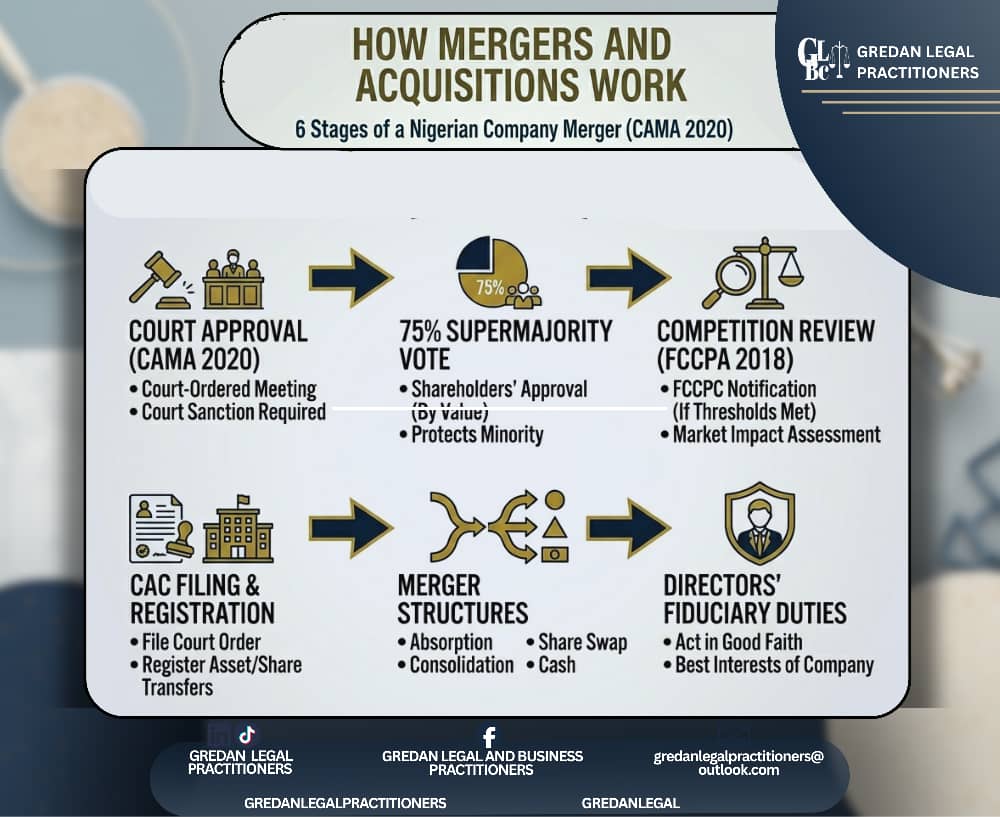
HOW MERGERS AND ACQUISITIONS WORK
Mrs. Bola had built Bola Industries Ltd from scratch.
For years, the company was profitable, well-structured and growing. Then things started slipping. There were cash flow problems, delayed financial statements, unclear board decisions and potential tax exposure that her lawyers had not properly brought to her attention.
Two months earlier, Kagan Industries Ltd had sent a merger proposal, which she sharply rejected. She believed her company would recover and return to profitability in no time.
Now, things are looking different.
With the company struggling, her lawyers have advised her to reconsider Kagan Industries Ltd’s proposal.
But what would the process actually look like for both companies?
Let us break it down into six stages.
1. WHAT DOES THE LAW SAY? — CAMA 2020
In Nigeria, mergers and other corporate restructuring arrangements are regulated by several laws, including the Companies and Allied Matters Act 2020 (CAMA 2020) and the Federal Competition and Consumer Protection Act 2018 (FCCPA 2018).
Under Section 711 of CAMA 2020, compromises, arrangements and reconstructions involving a company and its members or creditors are subject to a court-supervised process.
Where the provision applies, the Federal High Court may order a meeting of the relevant shareholders or creditors to consider the proposed arrangement.
The arrangement must then receive the required statutory approval and, where applicable, the sanction of the Court before it can take effect.
This means that a merger is not simply a matter of two companies signing an agreement and announcing that they have combined. The transaction must comply with the applicable legal and regulatory requirements.
2. THE 75% RULE: ONE PERSON CANNOT DECIDE ALONE
Section 711(2) of CAMA 2020 provides for approval by at least three-quarters in value of the shares represented and voting at the relevant meeting.
This is commonly referred to as a 75% or supermajority requirement.
Going back to our example, even if Mrs. Bola owns 60% of Bola Industries Ltd, she cannot simply decide on her own that the company will merge with Kagan Industries Ltd.
Where Section 711 applies, the required statutory threshold must be satisfied at the relevant meeting.
The purpose of this requirement is to ensure that significant corporate arrangements receive the level of shareholder approval required by law, rather than being determined solely by one shareholder.
3. COMPETITION LAW STILL APPLIES — FCCPA 2018
Shareholder approval is not necessarily the end of the process.
A merger may also be subject to Nigeria’s competition laws.
The Federal Competition and Consumer Protection Act 2018 regulates mergers and gives the Federal Competition and Consumer Protection Commission (FCCPC) powers to review certain transactions.
Under Section 92 of the FCCPA, a merger generally involves the direct or indirect acquisition of control over the whole or part of the business of another undertaking.
Section 93 further provides for notification of certain mergers to the FCCPC.
Where a proposed transaction meets the applicable requirements and thresholds, the parties may be required to notify the Commission and obtain the necessary regulatory approval before completing the transaction.
The FCCPC’s review focuses, among other things, on the potential effect of the transaction on competition.
Therefore, Mrs. Bola and Kagan Industries Ltd cannot treat shareholder approval as the only regulatory requirement. They must also determine whether the proposed transaction requires competition-law notification and approval.
4. FILING WITH THE CORPORATE AFFAIRS COMMISSION
Once the necessary court and regulatory requirements have been satisfied, the transaction must still be properly documented and the relevant filings made.
The applicable court order and other required documents may need to be filed with the Corporate Affairs Commission (CAC).
Depending on the structure of the transaction, there may also be requirements relating to changes in shareholding, corporate records, company information, assets and other aspects of the restructuring.
Proper completion of these filings is important because a transaction can involve several legal steps beyond the initial agreement between the companies.
5. NOT ALL MERGERS LOOK THE SAME
A merger or acquisition does not necessarily follow one standard structure.
In an absorption merger, one company effectively absorbs another, with the surviving company continuing the business.
In a consolidation, two companies may combine to form an entirely new corporate entity, subject to the applicable legal structure and approvals.
There may also be transactions involving a share swap, where shareholders of one company receive shares in another company as consideration for their interests.
Another possible structure involves cash consideration, where shareholders receive monetary consideration for their interests.
The structure chosen can have significant implications for ownership, control, governance, taxation, liabilities and the future direction of the business.
For Mrs. Bola, therefore, the question is not simply whether she should accept Kagan Industries Ltd’s proposal. She must also understand how the proposed transaction will be structured and what that structure means for her company and its shareholders.
6. DIRECTORS CANNOT ACT CARELESSLY
A merger is a major corporate decision, and directors cannot simply approach it as an ordinary business transaction.
Before recommending or approving a merger, directors must consider their legal duties and act in accordance with the requirements of CAMA 2020 and other applicable laws.
Directors are expected to act in good faith, in the best interests of the company, and to properly manage situations involving conflicts of interest.
They must therefore carefully consider the company’s financial position, the terms of the proposed transaction, the interests of shareholders and other relevant stakeholders, and the potential consequences of the restructuring.
In Mrs. Bola’s situation, the fact that Bola Industries Ltd is experiencing financial difficulties does not mean that the directors can accept any proposal placed before them without proper consideration.
The proposed merger must be carefully reviewed, negotiated and subjected to the necessary legal, financial and regulatory due diligence.
CONCLUSION
A merger or acquisition is much more than two companies agreeing to become one.
It can involve shareholder approval, court proceedings, competition-law requirements, regulatory filings, corporate restructuring, tax considerations and directors’ duties.
For Bola Industries Ltd, accepting Kagan Industries Ltd’s proposal would therefore be only the beginning.
Before the transaction can be completed, both companies must determine the appropriate structure, satisfy the applicable legal and regulatory requirements, conduct proper due diligence and ensure that the interests of the companies and their shareholders are properly considered.
The process may be complex, but understanding the legal framework helps companies approach mergers and acquisitions with greater clarity and fewer surprises.
This article is provided for general legal information and should not be regarded as legal advice on any specific merger, acquisition or corporate transaction.