

Bridging the Divide: Why Equality and Equity Must Work Hand in Hand
September 14, 2026HOW MERGERS AND ACQUISITIONS WORK.
September 17, 2026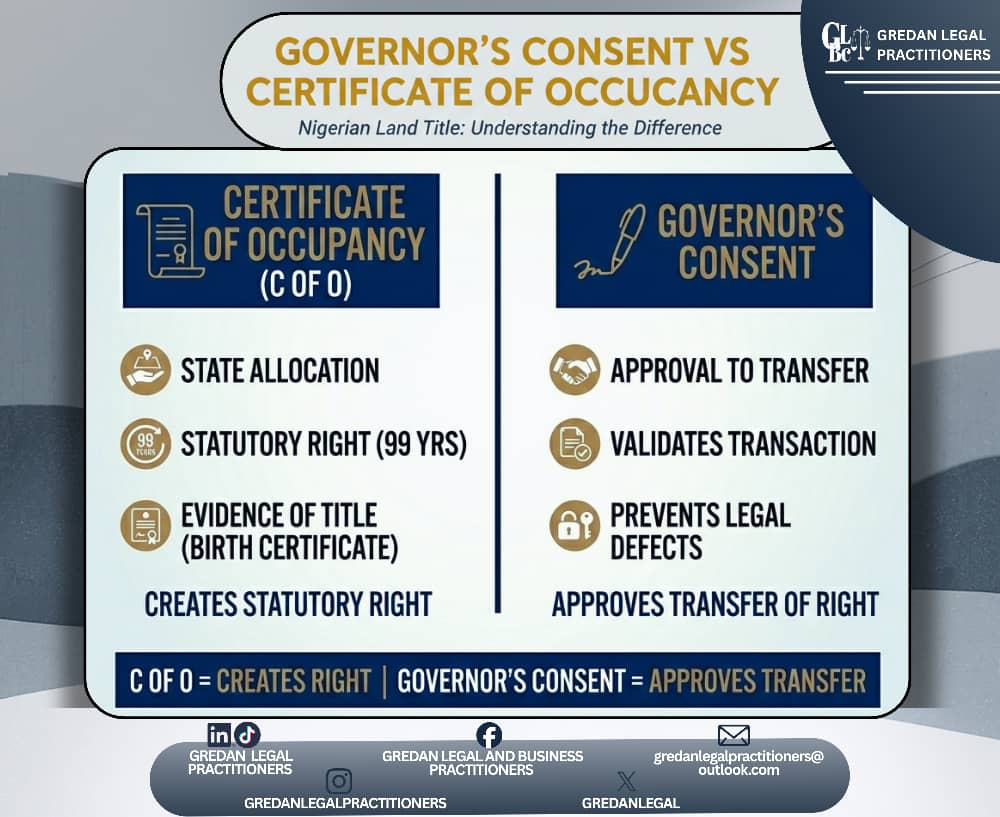
GOVERNOR’S CONSENT VS CERTIFICATE OF OCCUPANCY: WHAT DOES EACH MEAN?
If you have ever purchased property in Nigeria or seen a land or property sale advertisement, you must have come across the terms Certificate of Occupancy (C of O) and Governor’s Consent.
But what exactly do these terms mean?
In Nigerian property transactions, these two concepts are often confused. However, they are not the same thing and serve different legal purposes.
Let us break down the distinction.
CERTIFICATE OF OCCUPANCY (C OF O)
Under Section 9 of the Land Use Act 1978, the Governor of a State may grant a statutory right of occupancy over land.
The document issued as evidence of that grant is known as a Certificate of Occupancy.
In simple terms, a C of O indicates that the holder has been granted a statutory right of occupancy over the specified land. The right is subject to the terms and conditions contained in the grant and is commonly for a term of 99 years, depending on the nature of the grant.
A Certificate of Occupancy is important evidence of the holder’s interest in the property. It is sometimes described as the “birth certificate” of the land, particularly where it represents the original grant of a statutory right of occupancy by the State.
However, it is important to understand that a C of O does not amount to radical title to the land.
Under Section 1 of the Land Use Act 1978, all land comprised in the territory of each State is vested in the Governor of that State, to be held in trust and administered for the use and common benefit of all Nigerians.
Therefore, a Certificate of Occupancy confirms a statutory right of occupancy over the land for the specified term; it does not mean that the holder has acquired the ultimate or radical title to the land.
GOVERNOR’S CONSENT
Now, imagine that the holder of a statutory right of occupancy decides to sell or assign the property to another person.
Does signing a Deed of Assignment automatically complete the transaction?
Not necessarily.
This is where Governor’s Consent becomes important.
Under Section 22 of the Land Use Act 1978, a holder of a statutory right of occupancy cannot alienate the right without the prior consent of the Governor.
Alienation in this context can include transactions such as an assignment, transfer, mortgage or sublease, depending on the circumstances.
Governor’s Consent therefore refers to the approval required from the Governor for a transaction involving the transfer or other dealing with an existing statutory right of occupancy.
For example, if Mr. A holds a statutory right of occupancy and wishes to assign his interest in the property to Mr. B, the required consent of the Governor must be obtained before the transaction can be validly completed in accordance with the law.
The absence of a required Governor’s Consent can have serious consequences for the validity and enforceability of the transaction.
THE CORE DIFFERENCE
The simplest way to understand the distinction is this:
A Certificate of Occupancy is evidence of the grant of a statutory right of occupancy.
Governor’s Consent, on the other hand, relates to the approval required for certain subsequent dealings with an existing statutory right of occupancy.
In other words, one concerns the grant of the right, while the other concerns the subsequent transfer or dealing with that right.
WHY THIS DISTINCTION MATTERS TO PROPERTY BUYERS
In practice, one common mistake property buyers make is assuming that receiving a Deed of Assignment means that everything concerning the property has been completed.
A Deed of Assignment is an important document, but the buyer must also determine whether the transaction requires Governor’s Consent and whether the necessary steps for perfecting the title have been completed.
This is why proper property due diligence is important before purchasing land or property.
A buyer should investigate the seller’s title, verify the ownership history of the property, check for existing encumbrances, determine whether the land is affected by government acquisition and confirm whether the necessary consents and approvals have been obtained.
Simply seeing a C of O or a Deed of Assignment should not be the end of the investigation.
CONCLUSION
A Certificate of Occupancy and Governor’s Consent are not interchangeable.
A Certificate of Occupancy is evidence of a statutory right of occupancy granted over land, while Governor’s Consent is the approval required for certain transactions involving an existing statutory right of occupancy.
Understanding this distinction is important because land transactions involve significant financial and legal consequences.
Before purchasing property in Nigeria, do not only ask whether the property has a C of O. Find out the nature of the seller’s interest, investigate the history of the property and determine what approvals and steps are required to validly transfer and perfect your interest.
Proper legal due diligence can help identify title defects and other issues before you commit your money to a property transaction.
This article is provided for general legal information and should not be regarded as legal advice for a specific property transaction.