
HOW MERGERS AND ACQUISITIONS WORK.
September 17, 2026DISCHARGE OF CONTRACT BY BREACH.
September 18, 2026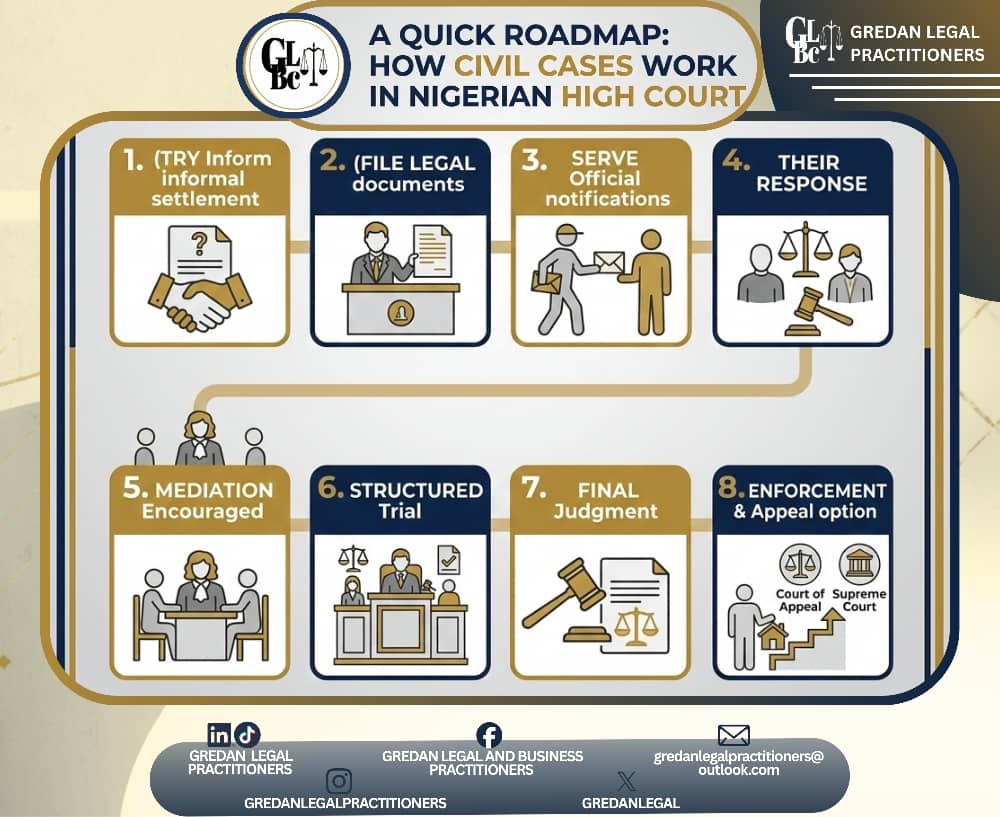
WHAT TO EXPECT WHEN TAKING A CIVIL CASE TO COURT IN NIGERIA
Thinking of Going to Court in Nigeria? Here’s What It Actually Looks Like
A lot of people are scared of court.
They imagine confusion, lawyers shouting across the courtroom, endless legal grammar and a process that they will not understand.
But if you strip away the wigs and gowns, going to a Nigerian High Court is, at its simplest, about asking a judge to help resolve a dispute because attempts to settle the matter have not worked.
So, what actually happens when you take a civil case to court?
Let us break it down.
1. FIRST, YOU TRY TO SETTLE THE DISPUTE
Going to court does not always have to be the first step.
In many situations, a person may first send a formal letter or demand asking the other party to resolve the issue. This could involve demanding payment of a debt, asking someone to return property, insisting that a contractual obligation be fulfilled or requesting that a particular action stop.
Sometimes, the matter is resolved at this stage.
If attempts at settlement fail, however, legal proceedings may become necessary.
2. YOU FILE YOUR CASE
If the dispute cannot be resolved, your lawyer will advise you on the appropriate legal action and prepare the necessary court processes.
The documents filed will set out the relevant facts of the case, the basis of your claim and the reliefs or orders you are asking the court to grant.
Depending on the nature of the case and the applicable rules of court, this may involve documents such as a writ of summons or originating summons, along with other supporting processes.
The case is then filed at the appropriate court registry and assigned a case number. The applicable filing fees must also be paid.
3. THE OTHER PARTY IS NOTIFIED
After the case is commenced, the other party must be properly notified of the proceedings.
This is generally done through service of the relevant court processes.
The purpose is to ensure that the defendant knows about the case and has an opportunity to respond to the allegations or claims being made against them.
4. THE OTHER PARTY RESPONDS
Once served, the defendant is given the opportunity to respond in accordance with the applicable rules and timelines.
The defendant may admit the claim, deny the allegations or raise their own defence and counterclaims, depending on the circumstances.
If the defendant fails to take the necessary steps to defend the case, the court may, in appropriate circumstances, proceed in their absence or make other orders permitted by the applicable rules.
However, a claimant does not automatically win every case simply because the defendant does not respond. The applicable procedural rules and the circumstances of the case determine what the court can do.
5. THE JUDGE ORGANISES THE CASE
Before the matter gets to a full trial, there may be preliminary proceedings designed to identify the issues in dispute and ensure that the case is ready for hearing.
The court may also encourage the parties to explore settlement.
Depending on the nature of the dispute and the applicable court procedures, the parties may be referred to or encouraged to consider alternative dispute resolution methods such as mediation.
This is important because not every case needs to end with a full trial. Where the parties reach an acceptable settlement, the dispute may be resolved without going through the entire trial process.
6. THE TRIAL
If the parties cannot settle the matter, the case may proceed to trial.
At trial, the claimant presents evidence in support of the case. This may include documents and testimony from witnesses.
The opposing party is then given an opportunity to challenge that evidence, including through cross-examination of witnesses.
The defendant will also have an opportunity to present their own evidence and witnesses, which the claimant’s lawyer may challenge through cross-examination.
The judge oversees the proceedings and determines the admissibility and consideration of evidence in accordance with the law and applicable rules of court.
7. THE JUDGE DELIVERS JUDGMENT
After hearing the evidence and arguments of the parties, the judge considers the issues before the court and delivers a judgment.
Depending on the nature of the dispute and the evidence presented, the court may grant the reliefs sought, award monetary compensation, make orders concerning property or restrain a party from taking a particular action.
The court may also dismiss the claim where the claimant has not established the case sufficiently.
8. WHAT HAPPENS AFTER JUDGMENT?
A judgment is not necessarily the end of the legal process.
Where a party obtains a judgment and the unsuccessful party refuses to comply, the successful party may take steps to enforce the judgment in accordance with the law.
The appropriate enforcement procedure will depend on the nature of the judgment. In some circumstances, this may involve processes directed at recovering money or enforcing an order against property.
There may also be a right of appeal.
A party who is dissatisfied with a judgment of the High Court may, where the law permits, appeal to the Court of Appeal. In appropriate cases, a further appeal may lie to the Supreme Court of Nigeria.
However, not every decision can automatically be appealed to the Supreme Court, and the right of appeal depends on the nature of the case and the applicable law.
IS GOING TO COURT FAST?
Not always.
Court proceedings can take time, depending on factors such as the nature and complexity of the dispute, the court’s schedule, procedural issues, the conduct of the parties and whether the matter is appealed.
Does it require patience?
Yes.
Is it impossible to understand?
No.
CONCLUSION
Going to court may seem intimidating, especially if you have never been involved in a legal proceeding before. However, knowing what to expect can make the process easier to navigate.
If you have a legal dispute, speak with a qualified lawyer about your options and the appropriate steps to take. The right legal guidance can help you understand the process and protect your interests.
This article is provided for general legal information and should not be regarded as legal advice for a specific dispute or court proceeding.